
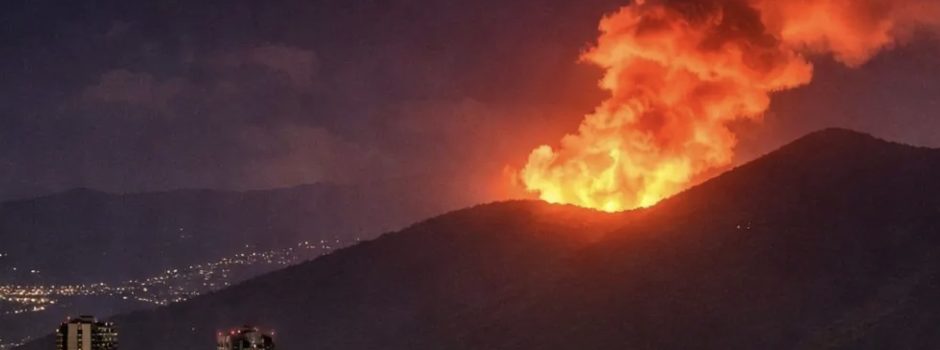
I was in the basement yesterday, looking for an old photograph, when Cary called out to me.
“Mark, are you down there?”
“Yes.”
“Have you heard what our government did last night?”
“No…” I said. “Do I want to know?”
“We invaded Venezuela,” she said.
**
January 6th – this coming Tuesday… is the twelfth night after Christmas. This is the night when we, in the Christian church, celebrate the Feast of the Epiphany.
In our tradition, Epiphany tends to be an afterthought of Christmas – a tradition that comes and goes with little to no fanfare.
Not so in other parts of the world.
In Spain, for example, children look forward to Epiphany as a morning when they will be given more gifts. They leave their shoes outside the door and find them filled with sweets in the morning.
In Warsaw, Poland, elaborately costumed figures appear in a massive Epiphany parade that takes over the streets.
In Turkey, an Eastern Orthodox priest throws a wooden cross into the freezing cold ocean, and hundreds of young men leap in to try and retrieve it. The first one to grab the cross is said to be blessed with health and prosperity.
In Bulgaria musicians with traditional instruments climb into a freezing river and play. They are soon surrounded by a circle of dancers who surround them in a big circle – all eager to display their great endurance and strength.
But wait.
Isn’t Epiphany when we celebrate the appearance of the three magi that arrive after Christmas to pay homage to the baby Jesus?
Do you remember any of the three wise men leaping into any frigid waters? I didn’t hear Liesie mention anything like that in the reading she just gave.
So why all this jumping in water?
Well, the story of the arrival of the Magi that Liesie just read for us is the primary association that we have for the Feast of the Epiphany, but for Christians in many other parts of the world, Epiphany celebrates three events that take place in Jesus’ life:
The first event is the appearance of the three kings
The second event is Christ’s baptism in the River Jordan and…
The third event is Christ’s first miracle at the wedding in Cana.
When you look up the word Epiphany, the first meaning that appears is the word’s association with a certain Christian feast day. But when you dig a little deeper you learn that, the word Epiphany, has its origins in the Greek root “phainein” which means to “bring to light” or “make appear.” This same root can be found in words like phantom and diaphanous. The prefix “Epi” adds the meaning “on, upon, above, or near.”
“To make appear on…” “To bring to light upon…”
In our religious tradition, Epiphany refers to the way in which the birth of Christ made the divine appear.
Christ, we say, is the incarnation of God.
So when we celebrate the Epiphany, we celebrate the miracle that we believe took place when Jesus was born. Each year, our tradition reaffirms the great assertion that when Jesus was born in the stable in Bethlehem, the Divine moved from the spiritual realm into the physical world in a way that had never happened before.
In the early Christian church, this incarnation of the divine was demonstrated by the three stories mentioned earlier: the arrival of the magi, the baptism of Jesus, and the miracle at the wedding of Cana.
Why these three stories?
Each story, it is believed, provides evidence of the actions of the Trinity. The miracle at the wedding of Cana, as Jesus’ first miracle, serves to establish the son’s own position in the Trinity. The baptism – with the immersion in the Jordan and the descent of the dove – reveals the working of the Holy Spirit and the arrival of the Magi places emphasis on God’s part.
This settles the question of the Turkish and Bulgarian Christians leap into the frigid waters… they are re-enacting Christ’s baptism – the epiphany of the Holy Spirit.
But how, then, is the appearance of the Magi the representation of the role of God? How do we figure that? Is there something about the way the Magi carry themselves that points us to God the Father?
**
When I came upstairs from the basement and did a little research I learned that what happened was not exactly an invasion as such.
American forces did perform a military operation in the Caracas, but it was not, as the word “invasion” suggests, a D-Day type assault on the nation of Venezuela.
According to General Dan Caine, who is the chairman of the Joint Chiefs of Staff, more than 150 aircraft launched from 20 different bases on land and sea across the Western Hemisphere last night. The “operation,” which had, apparently, taken months to plan, culminated when Nicolàs Maduro, the President of Venezuela, and his wife, Cilia Flores, were dragged from their bedroom by elite US forces and forcibly taken into custody.
**
The story that Liesie read for us only appears in one gospel: the book of Matthew. It describes a journey that is undertaken by some characters that the text calls magi from the east.
The passage always refers to these characters in the plural, so we know there was more than one of them, but there is no clear indication that there were exactly three of them. The number three seems to have been decided by tradition – like the Christmas carol “We Three Kings.” In other traditions they are called the “three wise men.”
Despite Matthews lack of precision, there are three solid observations that can be made about these travellers:
One: They were highly respected people.
Two: They came from distant nations, and…
Three: They were on a mission.
These were greatly respected people, but they were not wearing neckties. They did not fly first class into Jerusalem International clutching a briefcase and a cellphone. There were no shareholders depending upon them to enhance their returns.
These men were travelling across national borders, but they were not wearing fatigues. They did not descend in the belly of a military copter wearing night vision goggles and clutching an automatic weapon.
They were not an “elite force.”
No.
So what were they? Why did they come all that way?
When these men travelled from distant lands, they did so on foot or on the back of a camel. Their intention was spiritual in nature, and so every inch of their journey over land and sea was measured by hope, by prayer, by the possibility of revelation.
This spiritual mission was revealed when they arrived in Jerusalem and started asking around:
“Where is the child who has been born king of the Jews?
… we observed his star in the east, and have come to pay him homage.”
They have come to pay homage.
You know…
There is a name for a person who travels great distances for the purpose of paying homage to the divine.
People on a spiritual mission are pilgrims.
We might call our visitors the “three pilgrims.”
They may not have stayed in five star hotels, but there are some advantages to being pilgrims. One advantage is that you don’t have to watch your back. You don’t have to spend months coordinating 150 aircraft launched from 20 different bases on land and sea across the Western Hemisphere.
When you are a pilgrim you are not a threat to anyone, and so no one is a threat to you. There is no need to be secretive, because everyone understands what you are doing. You have dedicated your journey to something larger than yourself. We have all been on such journeys.
We all get it…
Or at least most of us do…
**
You don’t have to go far to find someone who does not understand the importance or the necessity of a pilgrimage.
A perfect example of such an individual shows up in the same story.
I refer, of course, to the infamous Herod.
If pilgrims travel great distances to pay homage to something that they acknowledge to be greater than themselves, Herod does the opposite stubbornly staying put, serving only himself.
When he hears that foreign dignitaries are in Jerusalem asking about the birth of the “King of the Jews” Herod gets spooked.
Hey! he thinks to himself – that’s my job! I’m the ruler here. I can’t have any other “king of the Jews” being born under my watch.
The intrigue commences immediately. There is no means other than deception that is even considered. Summoning our Pilgrims, Herod tells them to seek the foretold child, and let him know his whereabouts so that “I may also go and pay him homage.”
Obviously, Herod did not intend to pay homage. He intended to kill Jesus.
But warned in a dream, the Pilgrims defied Herod and went home “by another road.”
So, in a fit of anger at being thus frustrated – and also to appease his fear of the child, Herod gives an order to kill all the children in the area under a certain age.
This is what is known as the massacre of the innocents.
**
The CNN website quotes General Dan Caine, the Chairman of the Joint Chiefs of Staff, who made these comments during a news Conference on Saturday morning:
“The operation, known as Operation Absolute Resolve, was discreet, precise and conducted during the darkest hours of January 2, and was the culmination of months of planning and rehearsal — an operation that frankly only the United States military could undertake,”
Meanwhile, President Trump posted a picture of Nicolas Madura in custody on a Navy Battleship. According to the President, we will “run the country.” He did not elaborate on how we will do that.
Nicolas Maduro was not a good man. If we can trust Wikipedia, I found, in that source the following, troubling statistics:
A Venezuelan human rights organization has identified more than 43,000 people whose “right to personal integrity” has been violated since Maduro took office in 2013, including 1,652 people who were tortured, 7,309 people who were subjected to “cruel, inhumane and degrading” treatment or punishment, and at least 28 people who were killed in the country’s prisons.
That said, removing a foreign leader is a dangerous precedent that violates the Charter of the United Nations.
How will this all pan out?
It remains to be seen.
**
Since these geopolitical events have rudely intruded upon our experience of the Feast of Epiphany this year, it seems appropriate that we should consider the story of the Magi, as an allegory that sheds light on the exertions of political power.
The examples that are placed before us are clear.
We respond to them.
There are leaders who work hard to honor something greater than themselves.
And there are leaders who serve only themselves, and seem willing to kill with casual decree.
Which is the more divine?
The pilgrim
or the tyrant?
Amen.