Beloved…
It was just a matter of time.
If we insist on categorizing human beings… If we insist on saying that an American citizen is more important than a human being who was born in another country…
If we insist on making this claim, even though God insists, to the contrary, that all humans are made in the Divine image, and that all humans are sacred…
If we insist on doing this…
Then this week, our worst fears have been realized.
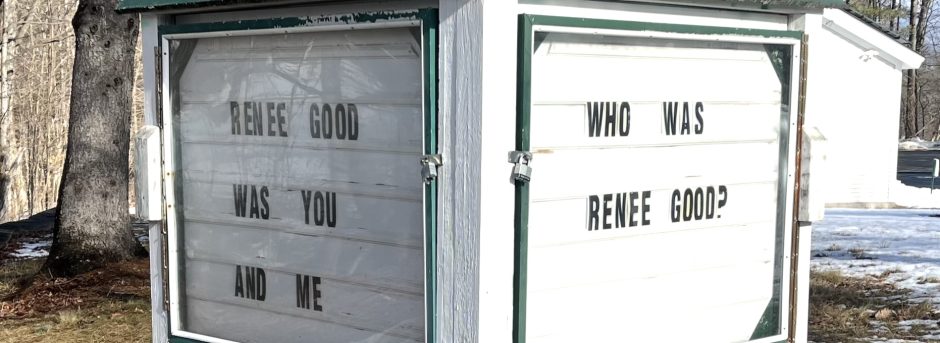
Renee Nicole Good was an American citizen.
She was the mother of young children.
I am not being political. I am not being melodramatic. I state a fact.
Renee Good is dead.
She is you.
She is me.
And she is dead.
**
One of the things that continually takes getting used to for me, is the way that the Bible can be so maddeningly matter-of-fact when it tells a story.
The passage that I just read for you from the Gospel of Matthew is no exception. The narrative is told as a series of events that take place one after another with very few details or adjectives. God’s spirit is described as being “like a dove.” But that’s about it. Was the water cold? Was God’s voice booming? Were there other people present? We don’t know any of this.
But when I read the story again this week – – I noticed something. In the middle of the reporting of events, I caught a glimpse of something…
Something I had not seen there before.
An emotion!
But it doesn’t come from Jesus.
Maybe this is why I hadn’t seen it before…
Since Jesus is the one being baptized – and we are all followers of Jesus – it is natural enough that we should tend to focus our attention on Jesus.
But there was someone else present that day.
John the Baptist was there too.
Were there other people there? Maybe. We don’t know. All that we know for certain – from the way the story is told – is that Jesus and John the Baptist were together, standing there in the waters of the river Jordan.
**
If you will humor me, for a moment, I will make a giant leap from the land of Israel, to the Indian subcontinent, where we will fall in with a young rogue named Krishna Gopala. As you may have guessed, we are not only leaping from country to country, we are also making the transition from Christian scripture to Hindu folklore.
About the only theme that this story share with the baptism of Jesus, is that they both take place in a river.
Krishna Gopala is a young Goat herder. He is also a God, though it is not clear that he is fully aware of his divine nature. This kid lives to get in trouble. He delights in being a young rascal.
One day, he comes upon some young maidens swimming in the river.
Their clothes are strewn on the bank.
Well… what do you think our mischievous young God does?
You guessed it!
There is really only one course of action that a self respecting prankster can do under such circumstances… and he commences to do just that…
He steals the clothes.
You could see that coming a mile off.
But wait…
Let us not forget one important detail that makes this roguish practical joke notably different from any other telling of this familiar tale of adolescent ribaldry.
The difference is, that when, at length, the maidens must get out of the water, their nakedness is not at all a matter of salacious interest.
Nothing of the sort.
This nakedness is a nakedness before God.
This nakedness is not a matter of shame. This nakedness has nothing to do with sexuality. This is a very particular kind of nakedness.
Naked before God.
We are always naked before God.
Aren’t we?
It’s just that we just don’t always know it.
**
OK, back to the River Jordan…
Before John the Baptist baptizes Jesus, the two have a short conversation.
Let’s zoom in on that for a moment.
When Jesus enters the River Jordan to be baptized by John, John says:
“I need to be baptized by you, and do you come to me?”
An emotion!
Anxiety.
In a moment of ironic clarity John acknowledges his humility and his need.
“I need to be baptized by you…
In Jesus’ presence, John is suddenly stricken with uncertainty.
“…do you come to me?”
What, you want me to throw the touchdown pass?
You want me to fly the plane?
You want me to cure cancer?
Even though he, John, has been busy baptizing all kinds of people, when he is in the water with Jesus he immediately acknowledges that what he really needs – and perhaps what we all really need – only Jesus can really give.
John the Baptist is not standing in the water with any old carpenter guy from Nazareth.
He knows that he is standing in the river Jordan with the messiah.
What if it was the fourth quarter of the Superbowl and instead of throwing the winning touchdown pass, Tom Brady flipped the ball over to you and said:
“Here, you give it a shot.”
Imagine you were in the middle of giving a sermon, and Martin Luther King Jr. walked in and sat down.
No pressure.
These scenarios sound like classic anxiety dreams.
They would never happen in real life.
Would they?
John the Baptist’s question: when he, in effect, says: “Who me? You want me to baptize you? – it feels a bit like one of these anxiety dreams.
An intense moment. The messiah is asking him, John the baptist, to perform a ritual that brings him, Jesus, into community with God.
Does John feel intimidated by Jesus?
Sure sounds like it…
**
I am a person who cannot live without writing – I think you know this about me. I’ve been doing it since I was old enough to hold a pencil, and I guess the coroner will need to wrench it, the pencil that is, from my clutches before the rigamortis sets in. Despite this… and despite moonlighting for a number of years as an English teacher, I have never been a great one for the finer details of grammar. So yesterday, as we were out performing an errand in her car, I asked Cary this question:
“Is the word ‘over’ a preposition?”
“Yes,” she said.
This is an example of our scintillating conversation.
“How about “in?”
“Yes,” she said.
“I thought so. I just wanted to make sure.”
Never losing an opportunity to enlighten me, she proceeded: “A preposition,” she said, “always has a noun or a pronoun as an object. It signals some relation to that object. It usually has to do with location or direction, or time something like that”
“I walked over ‘the bridge’” I said.
“Yes, she said. “the bridge is the object of the preposition “over”
“I jumped in the river.”
“Yes.” she said. “those are both prepositional phrases that describe some relation that you have with the bridge or the river.”
The reason I am relating to you these feats of intellect, is because when I think of the River Jordan, I often think of the phrase “Over Jordan.”
The phrase shows up in African American Spirituals like “Swing Low Sweet Chariot:
“I looked over Jordan and what did I see”
In this case, the River Jordan represents a kind of symbolic border between life and death – or perhaps between heaven and earth.
It could be the experience of death.
Or perhaps the River Jordan is life itself, and “over Jordan” is the other side – where we meet God.
The point that I am trying to get at here, is that John the Baptist was in Jordan.
This story, for the most part, is told as a matter of fact series of events, but we do see, in that one comment from John, that is profoundly aware is in the very midst of something amazing. Something intimidating.
Something real!
He is in the Jordan river, with the Messiah.
He is in it.
He is submerged, as it were, in the crucial moment of his life. He is not outside. Nothing is fake here. It is all intensely real.
You could say that he is “naked before God.”
I would like to think that this – this being in Jordan – is the essential thing about being a person of faith.
I recall a sermon I gave a few years ago, in which I told you a story about one night when I was on-call in the hospital, and I found myself in a room with a man whose mother had just died.
I endeavored to tell you as many of the details of that story as I could recall, so that you could understand what a terrifying experience that was.
I knew that his mother had died, but he did not know yet.
How was I to tell him?
I struggled, in that sermon, to express to you the awfulness of that moment. I struggled to find the meaning in it.
Perhaps I was in Jordan.
The moment demanded a deep and complete presence. It could be no other way.
Need I say it?
The killing of Renee Good – like the Kent State and George Floyd, is an in Jordan moment in the history of our nation.
This is not hypothetical.
We do not look “over Jordan” at what is happening.
We are in it.
This is the moment – the holy moment that tests our moral integrity.
We are “naked before God.”
What do we do?
I ask you.
As people of faith, what do we do?
Amen.