John’s Gospel, which we just heard from, tells us that the sun had not yet risen on that first Easter morning, when Mary Magdalene arrived at Christ’s tomb.
The text is quite specific about this detail. “…while it was still dark,” the text says “Mary Magdalene came to the tomb…”
I have heard it said that the darkest hour is right before dawn.
Is this true?
I asked Cary. Cary is my wife.
“It’s an old saying,” she said. “I don’t know if it is scientifically true, but old sayings don’t come from science. They come from life.”
I love that. “Old sayings don’t come from science. They come from life.” I’m glad to be married to such a straight forwardly wise person.
I love the way a claim can be utter nonsense and the height of wisdom at the same time. Religion and poetry share a surprising and wonderful ability to embrace this kind of paradox. It is this generosity of meaning, and the resulting doorways into mystery that keep me endlessly fascinated.
In Mary’s case, though, whether we are talking about nocturnal atmospheric conditions, or we are talking about the dark night of the soul – either way we look at it, this is a dark hour for Mary Magdelene.
In other gospel accounts of this moment, at least she has some other women with her.
But in John’s Gospel she is alone.
Alone in the dark.
On a dark errand.
Let’s take a moment to appreciate Mary’s great strength. I can imagine that she is breathing hard – not merely from the early morning walk, but also in an attempt to still her heart. She has bent her steps, knowingly, toward a lonesome place that is inhabited by the dead.
Much has been said about the fact that, in all four gospels, the first of the faithful to make their way to Christ’s tomb were women. I too find this fact compelling. It feels all the more so when I think in this way about Mary – about how lonely and scared she must have been at that moment, and how, nevertheless she persevered. A few nights before, when he gathered his disciples together for a last meal, Christ had given them his last commandment – to love, even as he loved them. What was Mary doing at this moment if she was not practicing that very commandment? Surely it was the great force of her love that kept her going in the midst of her darkest hour.
It is not hard to imagine, then, how unsettling it must have been for her – how terrifying, really – to see the mouth of Christ’s tomb unexpectedly open.
The stone, the text says, had been
removed from the tomb.
**
A University of Connecticut Geologist by the name of Robert Thorson, wrote a fascinating book that I read a few years ago, entitled “Stone by Stone” The Magnificent History in New England’s Stone Walls. On page 238 of this book Thorson suggests that there is a difference between rocks and stones.
I never thought to distinguish between a rock and a stone. In my book, they have always been interchangeable nouns. Thorson, though, draws a distinction between the two:
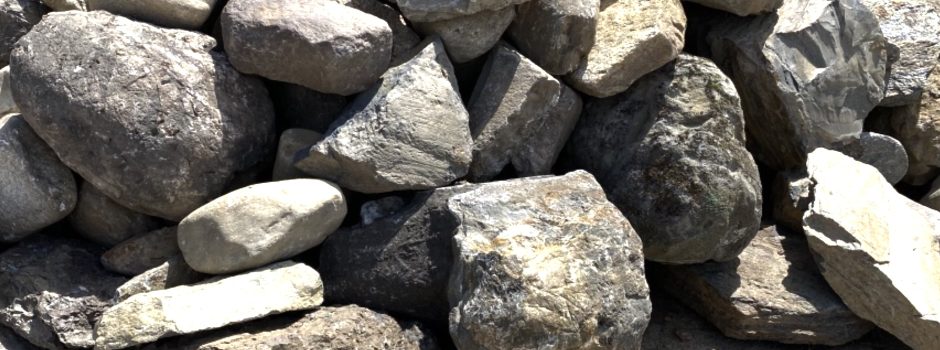
Thorson claims that a rock is a naturally occurring object – a geological feature that you see on a hillside or stub your toe on in an open field. A stone, on the other hand, “connotes human handling or use.”
Physically, of course, they are the same object, but a rock exists in its own setting, whereas a stone is something that has been taken and used for a human purpose.
When human intention and ingenuity gets involved, a rock is transformed into a stone.
A rock has no intention.
A stone has been given a purpose.
A rock is a thing.
A stone has a meaning – a meaning that we, humans, have given it.
Human intention and ingenuity being endlessly versatile, there are a million ways that rocks become stones. Valued for their strength and weight, we typically reach for rocks when we want to make something solid that we intend to endure for a long time – something like a foundation or a wall.
Something that will stay put.
Something to, say, cover the opening to a tomb, for example…
Now the Roman Empire – the Empire that occupied Israel during the time of Jesus, was the most accomplished of the early pioneers in the art of turning rocks into stones. Some of the most magnificent feats of engineering – public infrastructure such as massive aqueducts and long cobblestone roads that stretched across Europe and into the British Isles, are lasting Roman monuments (remnants of which can still be found today). The Romans made all this out of stone.
Rocks are heavy. But the Romans were good at moving them.
This may account for Mary’s first reaction when she arrives at the tomb and finds that the stone has been pushed aside. She doesn’t investigate what happened, she just assumes that “they” – the Romans – are up to something. Finding Peter, she tells him:
“They have taken the Lord out of the tomb, and we do not know where they have laid him.”
The force of Mary’s assumption is strong, and it is understandable that it should be, The Romans had all the political and military power in Israel at the time. Christ was convicted by a Roman Governor, and died on a Roman Cross. Mary naturally assumes that the rock too, has been moved by the Romans.
Who else would have moved it?
Who indeed?
We have a ready answer to this question don’t we?
We don’t share Mary’s first conclusion because, as impressive as they were, for us the Romans are a minor side show. Our reckoning of these events is defined by a lifetime of being taught that this is a sacred story – a story that tells us about the actions of God in the world. So even though the opening of the tomb is never actually described in the Bible, we conclude that the rock was moved by Divine intervention – either an act of God, Jesus himself, or maybe an angel.
We accept this part of the story almost without question. Of course, God moved the rock. It would be nothing for the creator of the universe to push a rock a few feet this way or that.
But allow me to point out that if we accept this idea, we must acknowledge that we are in new territory.
Because it’s one thing for a rock to be transformed into a stone through the action of human ingenuity and intention, and it’s another thing altogether for rock to be transformed into a stone through God’s intention and ingenuity.
**
When Mary arrived at Christ’s tomb, in the darkness before dawn, she expected to see a stone covering the entrance of the tomb.
This expected stone – the stone that covered the entrance – was the stone of Empire.
When the Romans put the rock there, their intention was to create a stone that stayed put. The Roman stone’s purpose was to sit in the place where they placed it – covering the opening of the tomb.
I had the occasion, in a recent sermon, to quote Sir Isaac Newton’s second law of motion to illustrate a point. I can do so again, here to good effect. Newton said that an object that is in motion tends to stay in motion unless a force acts against it – and likewise, an object tends to remain at rest unless a force acts to propel it into motion.
In our human experience, a big rock that is placed in a specific spot, is likely to stay in that specific spot, unless some external force acts to push it into motion.
This particular stone – the one at the opening of Christ’s tomb – is a stay-put stone. Its purpose is to contain the rabble rouser, Jesus Christ. When the stone stays-put in this way, it serves the Empire by erasing Jesus from our memories. Staying-put, it is the stone that serves Empire.
If, in the hands of Empire, a big rock is transformed into a stay-put-to-erase-Jesus-from-our-memory stone…
What does such a rock become when God transforms it into a stone?
That stone – the stone transformed by God – is the moved stone.
Human stones stay put.
God stones move.
What is the meaning of the moved stone?
Well, for one thing, the moved stone creates an opening.
Where there was a closing, there is now an opening.
God’s moved stone made an opening…
But an opening only means something when someone – someone alive – can move through it.
So if the human, stay-put stone buried a dead Jesus in hopes that he would be forgotten, God’s moved stone frees the risen Christ to move out into the world.
Where he will never be forgotten.
God’s moved stone is the opening stone… the setting free stone…
Freedom of movement that creates life.
Free to move, Christ rises.
Free to live, Christ emerges from the tomb.
And how good and proper it is that our faithful friend Mary was the first person to encounter the Risen Savior…
Through the darkness she had come, the darkness of the night and the darkness of her grief. Another darkness – the hostile intention of Empire that sought to bury and forget her beloved teacher, had held her in its sway. And yet she was resolute, remaining at the tomb, even after the other disciples departed.
Mary’s story, until this point, has been the story of a woman navigating darkness. Even when she sees Jesus she does not break through. She is confused. Thinking him the gardener, she says:
“Sir, if you have carried him away, tell me where you have laid him, and I will take him away.”
It is only when he calls her by name, that she recognizes him…
This is Mary’s moved rock moment.
When she recognizes Jesus, her rock is moved and becomes a stone… a bright light penetrates the darkness chasing away the shadows.
So, with Christ’s resurrection, Mary too is brought out of the darkness
She too has a renewed life.
The first of many lives that Jesus Christ would renew.
On this Easter morning, Jesus Christ is not dead and forgotten.
Jesus Christ, the moved stone.
The opening.
The life.
Amen.