The United Church of Jaffrey
  • Home
  • About Us
    • Staff
    • Visiting Us
    • Building Rental & Use Policies
  • Worship
    • Sermons
    • Poetry Corner
    • Music Program
  • Education
    • Sunday School Program
    • Adult Education Opportunities
  • Church Governance
    • Monthly Minutes
    • Reports
  • Pathfinder
  • Calendar
  • Church Events

A Painting of Jesus

February 22, 2026 / admin / Sermons

Scrioture Passage

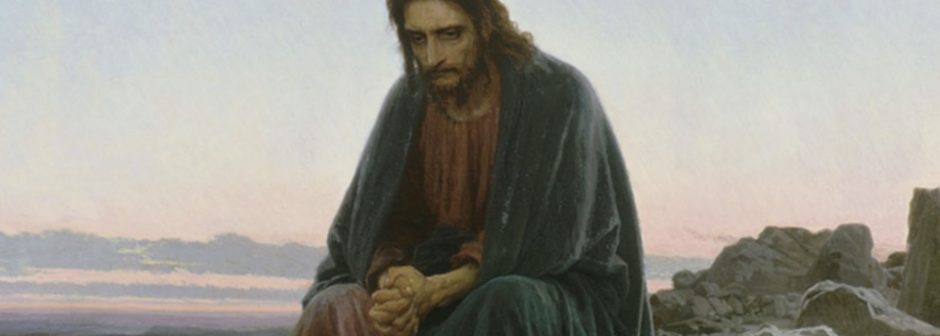
In addition to the verses from the fourth chapter of Matthew that Owen just read for us, I want to take, as my text this morning, the painting that graces the front of the bulletin. 

The image, as you can see, is a depiction, by the Russian artist Ivan Nikolaevich Kramskoĭ, of Christ during his forty day wandering in the wilderness.  It is aptly titled, Christ in the Wilderness.

I encountered this image on the online resource from Vanderbilt Theological Seminary that I use every week to look up the scripture readings that the Revised Common Lectionary tasks me to present to you for your spiritual nourishment.  The website bends over backward to provide a variety of resources intended to help the languishing Pastor jump start his or her creative process, but of these other resources I remain willfully ignorant, as it is woven into my character to obsessively avoid consulting such materials.   The last thing in the world I want is for someone else to tell me what they think of the lectionary selections.  That would ruin my whole process!  I avoid movie trailers and prefaces to novels too – and for the same reason.  The greatest satisfaction I have, reading any scripture, is the joy of being snuck up on and surprised in some unexpected way.  If, prior to reading, I availed myself of someone else’s interpretation, I inevitably find myself so busy working out whether I agree with, or refute that person’s ideas, that the delight of my own fresh impression is utterly lost.     

I mention all this because, of course, this week, all those fine sentiments went out the window when I discovered this painting of Jesus on the Vanderbilt website displayed above this week’s lectionary readings.  

It was one of those images you find on the internet that you click on to enlarge, so, unable to resist, I took a closer look.    

You might object and say that the visual arts are a different animal entirely from Biblical commentary in written form, and I would readily agree with you.   Prominent Biblical scholars who opine about a scriptural passage will tell you exactly what they think and back it up with all kinds of evidence, textual and historical.  This is often valuable and can be totally fascinating, but it can, just as often, leave me feeling claustrophobic, like my spiritual imagination has been penned up by too much logic.  

A painting is different somehow.  It certainly does offer an interpretation, but it appeals more to the emotion than the intellect.  You can look at a painting and draw your own conclusions because, in essence, it is more of a description than a definition.   A painting doesn’t make an argument so much as leave an impression. 

You have heard me speak of the difference between definition and description before – it is one of my favorite subjects of speculation.  There are those – astronomers who calculate the distance between stars, engineers who design bridges, and publishers who print dictionaries – who make a profitable and excellent living in the world of definition.  I admire them.  These people base their meaningful contribution to the well being of humanity on one supremely elegant and infallible truth: that one plus one has always, and will always equal two.  

I, on the other hand, live in the world of description.  In this world there is very little certainty, because the terms are not exact.  A perfectly delicious adjective like “threadbare” when applied to a well loved pair of jeans will conjure holey knees to one mind, and patched knees to another.  But it is this lack of precision, itself, that makes the land of description the land for me… and, I venture to say, the land where people of faith can feel most at ease.

Why?

Because you cannot define God.  The moment you do so, you have defined something other than God.   It’s as simple as that. 

Of course this hasn’t stopped people from trying to define God.  But people who define God are almost always engaging in the greatest sin of all – which is defining God in their own image – that is, the image of their own desire for power.   History is full of such people – usually tyrants – in whose self-serving, megalomaniacal hands, God becomes the unwitting ally of all manner of unrestrained evil.

On the other hand, I think that it is not only fine, but  crucial, inevitable even – to describe God.  We are God describing creatures, compelled, from the time we first painted animals on cave walls, to try to imagine the mysterious power that creates, sustains, and takes us away again, into the vastness of eternity.   

When we do this – when we describe God – we do so not through calculation, but through worship.  We are not measuring something physical, we are imagining something spiritual.

But wait…

What about Jesus?

Wasn’t Jesus something physical?

Here we encounter the most audacious, and perhaps the most mysterious assertion of our Christian faith.

That God can become flesh – can incarnate as Jesus and walk among us.

So, unlike our Jewish and Muslim brethren, when we Christians attempt to describe God, we don’t have to resort to vague symbols.  

I am not saying that Christians are better, just that, when it comes to art, we have a model who we can paint.  We can describe God by describing the person of Jesus.

So let’s take another look at this painting.

Isn’t it fascinating?

If we didn’t know better, this looks like the painting of a man.

 You would think that an individual who we, and millions of people throughout history, have believed to be uniquely Divine… surely if we painted a picture of such an individual he would be depicted using the symbols that we associate with powerful!  Isn’t the creator of the universe supposed to be omnipotent?  All-powerful?  

But the person in this painting has no crown, no scepter, no throne.  None of the traditional trappings of power are present…  unless you call the hard bare rock a throne.  There are no armies in the background awaiting his command.  He is not riding a magnificent horse, or heroically brandishing a sword endowed with mythical powers.   

No silk robes.  No palace.   No entourage of concubines.  

This man is in the desert.  There are no shoes on his feet.  His body language – in particular the look in his eyes, the slump of his shoulders  and the tension in his clenched hands – all suggest that this son of God – if that is indeed who he is – is in the very midst of suffering a bout of acute bone-deep exhaustion.  

Let’s not forget, this man has not eaten for forty days and forty nights.  So far as we know, he has not slept in a bed, or spoken to another person in all that time.

And yet, for all the humble clothes, and run down, hungry aspect, this man does not seem weak.

No.

He may not be surrounded by the traditional trappings of power, but this does not mean that he is not powerful.

Indeed, to me, the thing that makes this painting extraordinary, is the way that the artist has somehow managed to reveal Jesus’ vulnerability and his power, at one and the same moment.    

It’s quite startling.

And there is something else…

People who have power in the conventional human sense – Kings and Queens and Dukes and Barons and the like, often appear above it all.  They don’t really have to care, because they are taken care of.  Power, among normal human beings, often presents itself as a kind of aloofness.  

There is nothing “aloof” about this man.  He is not above anything.  He is in it. 

If ever a man was in it… it is this man.  For forty days and forty nights he has slept in the wilds, in the dubious shelter of rocks or arid scrub.  Could he even build a fire?  We don’t know.  I hope he had that one solace against the depths of the cold desert nights.  

Driven by the Spirit.  

Moving from place to place. 

Dogged by thirst and hunger.   

How does a man, alone, and stripped of all the mechanisms that human communities offer to keep him alive… how does such a man, suffering mortal fatigue and hunger… how does such a man know God? 

Not by being aloof!

We humans associate power with luxury, but it seems that God associates power with deprivation.

And, when you think about it, doesn’t this make sense?  

Which environment do you think would create a person of strength and integrity?  The royal parlor replete with  velvet fineries and courtiers to satisfy every whim?  Or the Judean wilderness where survival itself is a matter of wit, stamina and extraordinary fortitude?    

The power of God is not the power to have, but the strength to have not.  

Jesus knows God – becomes God-like – by being entirely in the depths of human hardship.  The wilderness demands it of him, without reservation.

**

Finally, this morning, I ask this a question of this painting:

 Does this painting depict Jesus before or after he is tempted by the Devil?

I wonder.

What do you think?

Whether it shows Jesus before the temptation, or after it, I am glad to discover that the painting has led me to a new understanding of the temptation.

While I was sketching out for you the difference between the aloofness of human power and the deep embeddedness of incarnate, Divine power, it occurred to me that the strength and integrity that Jesus attained during his  wilderness wanderings were, perhaps, the perfect preparation for the Devil’s test.

Jesus could easily brush aside the vanities that the Devil played upon.  He had spent a long time learning to discipline his body without food, so the pleasure of sustenance (turn these rocks into bread) could be set aside, at least for the time being.

The desert prepared him to resist the second temptation.  We test God to protect him from injury?  The fortitude and self-reliance created by forty days and nights in the wilds gave him the strength to trust his own ability to survive.  

And was the third temptation even tempting to Jesus?  Was he even interested in being king of the world?  

I doubt it.  

He was already far too powerful for such a frivolous job as that.

Amen

Comments are closed.

Address: 54 Main Street, Jaffrey, NH 03452

  • General Information: (603) 532-7047
  • Office (no confidential email): ucj1office@gmail.com
  • Pastor: pastorucj@gmail.com
(c) 2017 United Church of Jaffrey
  • Privacy Policy
  • Members
  • About

MATTHEW 4:1-11
Then Jesus was led up by the Spirit into the wilderness to be tested by the devil. He fasted forty days and forty nights, and afterward he was famished.
The tempter came and said to him, “If you are the Son of God, command these stones to become loaves of bread.” But he answered, “It is written, ‘One does not live by bread alone, but by every word that comes from the mouth of God.’”
Then the devil took him to the holy city and placed him on the pinnacle of the temple, saying to him, “If you are the Son of God, throw yourself down, for it is written, ‘He will command his angels concerning you,’ and ‘On their hands they will bear you up, so that you will not dash your foot against a stone.’”Jesus said to him, “Again it is written, ‘Do not put the Lord your God to the test.’”
Again, the devil took him to a very high mountain and showed him all the kingdoms of the world and their glory, and he said to him, “All these I will give you, if you will fall down and worship me.”Then Jesus said to him, “Away with you, Satan! for it is written, ‘Worship the Lord your God, and serve only him.’”
Then the devil left him, and suddenly angels came and waited on him.

Close