I recall, from college days, a certain hill that was located on the southern edge of the Bates campus. It was called “Mount David.” I don’t know who “David” was, but if, by naming the hill in that way, someone intended to do honor to that David, it was a dubious honor at best, because, as geological features go, it was not much more than a ripple in the landscape… its peak barely loftier than the dorm that it hid behind. To call it a mountain was certainly putting too fine a point on it. You could scramble to its summit in less time than an average commercial break. It might have been more accurately called a bump.
Bump David.
But in spite of its humble dimensions Bump David was a favored haunt. There was a view from up there, and who can resist a view that comes at such a low cost? Perhaps because of its position on the edge of campus, the most frequent parishioners who congregated atop Mount David were young people like myself – kids from both the college and the town who, suffice to say, observed rituals that were of a different sort then the rituals observed here in church.
**
Last summer, Cary and I took part in a walking tour of the Outer Hebrides. On one of the final days of the trip, the group walked a long loop around an Island called Bernaray. It was one of the longer hikes on that trip, and by mid afternoon, we’d made our way through a number of different ecosystems – wide pastures, rolling dunes, and long stretches of beach. When, at length, we turned our steps inland from the coast, I stopped to gaze for a weary moment at the long hillside before me.
“We’re going up there?”
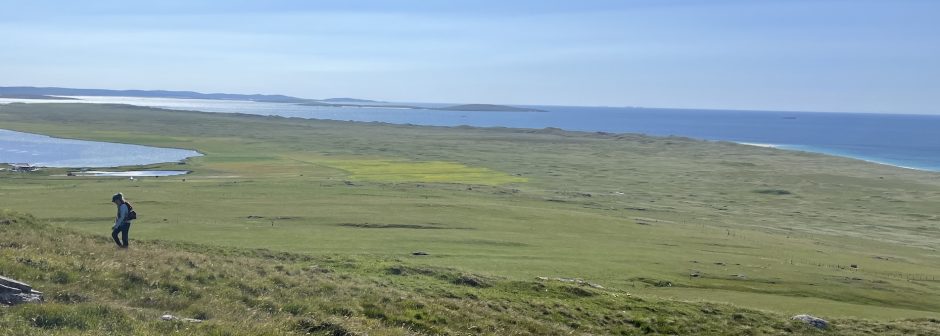
It wasn’t a tall mountain, but the long slope felt daunting. Part of the way up, I turned around and took the picture of Cary mid-climb,that, of course, is the photograph that graces the front of this morning’s bulletin.
As you can see, it was a beautiful day, and when we reached the top of Bernaray it seemed like the whole sweep of the Hebridean archipelago lay before us. This line of more than 100 islands, (located several hours by ferry, from the Scottish mainland) form the far western vestiges of Great Britain. From their southern reach at Barra Head, to their northern extremity at the Butt of Lewis, the Outer Hebrides are roughly 130 miles long. In 2024, the population was a little over 26 thousand (which, to put it into perspective, is only a fraction greater than the population of Keene.) This sparse human presence yields a deliciously ominous feeling of being outside of time. You can sometimes drive for 10 or 15 minutes at a time without seeing much of any evidence of human habitation. You begin to wonder if you might not drive off the edge of the world.
Indeed, looking west, from that vantage, there would be nothing but 3 thousand 100 nautical miles of eternity that would separate the weary mariner from landfall on the distant shores of Nova Scotia.
**
On April 3rd, 1968, Dr. Martin Luther King Jr. approached a bank of microphones at the Mason Temple Church of Christ Headquarters in Memphis Tennessee.
Dr. King was tired that night. It was his second trip to Memphis in so many months – making good on his promise to support the Memphis Sanitation Strike that had begun in February of that year. He told his close associates that he really didn’t feel up to speaking that night, but they prevailed upon him to rally his people, and he agreed.
Among the many things Dr. King related that night, he told us about the time, ten years prior when, in September 1958, a woman approached him at a book signing and stabbed him in the chest.
I was rushed to Harlem Hospital. King said… the X-rays revealed that the tip of the blade was on the edge of my aorta, the main artery. And once that’s punctured, you’re drowned in your own blood — that’s the end of you. It came out in the New York Times the next morning, that if I had merely sneezed, I would have died.
Dr. King then told us about a letter that he received while he was in recovery, from “a ninth-grade student at the White Plains High School.” According to Dr. King, the child wrote:
“I read that if you had sneezed, you would have died. And I’m simply writing you to say that I’m so happy that you didn’t sneeze.”
Warming to this theme, Dr King said:
I too am happy that I didn’t sneeze.
Because if I had sneezed, I wouldn’t have been around here in 1960, when students all over the South started sitting-in at lunch counters. And I knew that as they were sitting in, they were really standing up for the best in the American dream, and taking the whole nation back to those great wells of democracy which were dug deep by the Founding Fathers in the Declaration of Independence and the Constitution.
If I had sneezed, I wouldn’t have been around here in 1961, when we decided to take a ride for freedom and ended segregation in inter-state travel.
If I had sneezed, I wouldn’t have been around here in 1962, when Negroes in Albany, Georgia, decided to straighten their backs up. And whenever men and women straighten their backs up, they are going somewhere, because a man can’t ride your back unless it is bent.
If I had sneezed I wouldn’t have been here in 1963, when the black people of Birmingham, Alabama, aroused the conscience of this nation, and brought into being the Civil Rights Bill.
If I had sneezed, I wouldn’t have had a chance later that year, in August, to try to tell America about a dream that I had had.
If I had sneezed, I wouldn’t have been down in Selma, Alabama, to see the great Movement there.
If I had sneezed, I wouldn’t have been in Memphis to see a community rally around those brothers and sisters who are suffering.
I’m so happy that I didn’t sneeze.
**
One night, my friend Scott and I decided to head up Mount David.
Scott and I were part of a tight circle of friends, but he and we didn’t really know each other well. It’s not that there was anything in particular separating us, it’s just that both of us were closer with the mutual friends we shared. Do you know what I mean?
We walked up the worn track, between the scrub oaks and scraggly pine. There were some other kids there, so we found our own spot on the exposed rock, and sat down.
South and west, the tenement rooftops receded like a jumble of neglected furniture in a dusty attic. Down where College Street ran up against Sabbatus Street, the neon sign for Luigi’s restaurant blinked in the night. Just up from there, the jagged spires of the Basilica of Saints Peter and Paul broke the horizon, and off to the right an abandoned shoe factory flanked the edge of the Androscoggin river.
There is something about a view that quiets me.
I am put in mind of the old Easter spiritual “Were you there?” that describes the feeling that comes over you when you witness Jesus, dying on the cross:
Oh, sometimes it causes me to tremble, tremble, tremble.
I tremble to see the glimmer of light in each window. A glow that, is not, as we otherwise might think, just a lightbulb carelessly flipped on in some squalid kitchen or bedroom – but is, really a kind of incandescence – a certain quiet hope that each human soul radiates as it passes, resolutely, through this sad world.
And I tremble to think that each of these souls is sacred, in its immeasurable beauty, even though, lost within the maze of daily routines, most have forgotten, or perhaps have never even known it.
I tremble to think of the angry shouts and the frightened screams; of the hungry children, and the broken furnaces; of the dead car up to its haunches in snow – and how Christ’s pain – God’s pain – mysteriously transforms it all into a strange and terrible beauty.
How can it be?
The silence is unbroken between us. Scott, too, is preoccupied with his own thoughts.
**
2026 being my tenth year among you, this morning marks the tenth time I have preached about Christ’s Transfiguration. The title of my sermon, today is “From the mountaintop.”
Not “on” the mountaintop”
Or “to” the mountaintop.
but from
From the mountaintop.
It is no coincidence that, at the very moment when, according tradition, Jesus is transfigured – the moment when he becomes fully Divine – that he and three of his disciples have made their way up a mountain.
A mountaintop is not in a normal place.
Insofar as it is possible for a physical place to be not “of” this world – the mountaintop is that place.
Like no other place, the mountaintop is not so much a place as every place.
From here… from here you look out over the places that, in your normal everyday life, you exist within.
The within life has a momentum all its own. By necessity, the within life demands a kind of tunnel vision that allows each of us to attend to the matters that must be attended to. But such momentum – such tunnel vision has an unfortunate side effect. It leaves us little to no opportunity to break through and see life’s sacred dimension.
When, at length, Cary and I and the rest of the group stood on the top of Bernaray, in the Outer Hebrides, I was enjoying taking in the 360 degree view, when I overheard Helen, one of the English ladies commenting on the view. My eyes followed where she was pointing.
“From up here,” she said “you can actually follow the entire hike that we have done today.” Pointing off to south east she said, “You can actually see ferry from here – and that, of course, is where we left the van. We walked through that series of little hills, past that monument, over through the dunes and onto the beach.”
Now that I caught her meaning, I could see see it all for myself… how we’d clambered over a stile and made our way down to the beach, and how the long stretch of sand had eventually led us into the cove, shaded from the wind, where we’d enjoyed our lunch, before turning, with the edge of the island, onto another long strand where, entranced by the clean water, I’d taken off my shoes and flirted with the incoming tide. And of course, immediately below us was the spot where we’d turned off the coast and set off up the hill.
It was with some delight and fascination that relived the day. While I’d climbed mountains before, the heavily wooded landscapes where I was accustomed to hiking had never before allowed me to see, with such specific clarity, the stages of the day that I could see laid out before me in this mostly treeless, windblown island habitat.
From the mountaintop, it is possible to take an elevated view of the experiences that would, otherwise, slide effortlessly into the oblivion of forgetfulness.
This reminds me of how Dr. King, who was a mere sneeze away from eternity, came to understand the value of the experiences that had been his to gather.
And this also makes me tremble.
Because the speech that Dr. King gave that night at the Mason Temple Hall in Memphis Tennessee, would be his last.
At 6:01 in the evening on the following day, April 4th, 1968, the great man, Dr. Martin Luther King Jr, would be shot dead by an assassin’s bullet as he stood on the veranda of the Lorraine Hotel.
It makes me tremble to think that Dr. King, was looking out from the mountaintop that night when he said:
Well, I don’t know what will happen now. We’ve got some difficult days ahead. But it doesn’t matter with me now. Because I’ve been to the mountaintop. And I don’t mind. Like anybody, I would like to live a long life. Longevity has its place. But I’m not concerned about that now. I just want to do God’s will. And He’s allowed me to go up to the mountain. And I’ve looked over. And I’ve seen the promised land. I may not get there with you. But I want you to know tonight, that we, as a people, will get to the promised land. And I’m happy, tonight. I’m not worried about anything. I’m not fearing any man. Mine eyes have seen the glory of the coming of the Lord.
Mine eyes have seen the glory of the coming of the Lord.
And it makes me tremble…
Amen