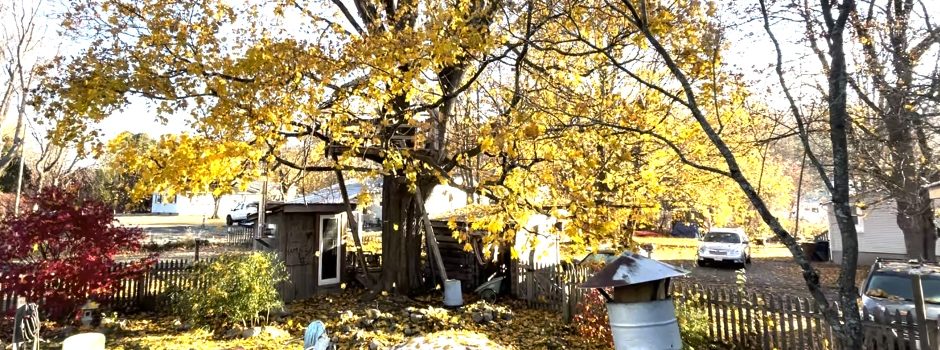
The leaf situation had gotten bad.
Cary and I were having trouble backing into our parking spots because the fallen Magnolia leaves had turned the whole area into one thick blanket of leaves. If I didn’t get them up before the next rain, it was going to get ugly. Besides, I was clearly not keeping up with the Jones’. The neighbors, who keep their yard spotless, were starting to give me dirty looks.
Thursday afternoon the weather was not exactly warm, but at least it was dry… so I suited up in some warm layers, heaved a sigh, and headed out to tackle the seasonal task of mid-November… the raking of the leaves.
Raking leaves.
Something happens to me everytime I do this kind of work. As I get into the rhythm of the work, I start to think, and pretty soon I end up ruminating about perfection and absurdity.
Perfection and absurdity.
Let me explain.
You can’t rake leaves without trying to do a good job of it – that’s true of any job. Your efforts are directed at a very particular goal – that is, removing all the leaves from your yard. You can’t do this without aspiring to get every leaf.
Every last leaf!
This is the pursuit of perfection.
But even as you are in the act of raking, you must admit to yourself that the notion of getting every leaf is an absurdity.
It can’t be done!
Even if you could get every leaf… (which you couldn’t!) the second you turned around another hundred leaves would flutter down from the Dogwood or the Norway Maple.
Scritch scritch scritch…
And another thing… while I am raking, I also find myself questioning the definition of “perfection” – the aspiration to get every last leaf out of my yard.
In a natural state – without my intervention – the leaves would decay until, in time, they would become part of the soil. Is this a bad thing? Even as they decay they provide habitats for the creepy crawlies that, in turn, feed birds and aerate the soil. The reason I am raking, apparently has little or nothing to do with the good of the ecosystem. If anything, I am interrupting the natural cycle because human culture insists that I do so.
I want my yard to be clean.
I want my neighbors to respect me.
So now I am thinking about the why of raking leaves. What is the intention behind my work?
It could be argued that I am acting out a kind of social contract that I have with my neighbors. When I do a good job… (not perfect, but good enough)… I can congratulate myself for doing my part to maintain the neatness of the neighborhood.
My work may be motivated by other people’s opinion, but the fruit of my labor is my good opinion of myself. In a way, I’m out here doing the work of propping up my ego.
Scritch scritch scritch…
This philosophical speculation about raking leaves reminds me of a story I once read about Abraham Lincoln. The following anecdote comes from page 57 of a book called Lincoln in Story, by Silas G. Pratt:
While Lincoln was practising law he used to go from one town to another to try cases before different courts. There were no railroads in those days, and traveling “on the circuit” (going around from court to court) was done mostly on horseback.
One day, when several lawyers besides Mr. Lincoln were traveling in this way, they came to a very muddy place in the road, and at one side, near the rail fence, was a poor pig stuck fast, and squealing as loud as possible.
The men thought this very funny and laughed at the unfortunate pig; but Lincoln said,
“Let us stop and help the poor thing out,”
But the others all poked fun at Lincoln, and so they rode on until they were out of sight and hearing of the suffering beast.
Lincoln rode on with them also, but little by little he went slower. He was thinking about the pig and…the memory of that pitiful squeal kept ringing in his ears. So Lincoln turned his horse and rode back alone. He found the poor thing still deeper than before in the mud and mire. So he took some rails from the fence, and putting them down by the squealing animal, made a safe footing to stand on. Then he took two other rails, and, putting them under the pig, pried him up out of the mud until he could reach him with his hands. Then he took hold of him, and, pulling him out, placed him on the dry sand.
This story about Lincoln sounds like a parable doesn’t it? It sounds, in fact, quite a bit like the parable of Good Samaritan. That said, it is interesting to note that even though Lincoln resembles the Good Samaritan, Lincoln himself did not tell this story to make himself look virtuous. Reflecting about it later, our 16th President suggested that he had turned around as much for himself as for the pig. He knew that, if he did not effect the rescue, the matter would gnaw at his conscience. So, he did not congratulate himself on his kindness, but simply recognized he had done the best for himself.
Even though his action in saving the pig showed a great deal of compassion and ethical integrity, Lincoln came to a similar conclusion that I came to about raking leaves. The intention that motivates my leaf raking is more about my selfish desire to look good to my neighbors than about any good that it may serve the earth. Lincoln recognized that his ethical act was selfish in the sense that it eased his mind about himself. He did it for the pig, sure… but he also did it so that he would be able to sleep at night.
The same can be said of any work, no matter how virtuous. One’s intention could be understood as selfish.
Is it even possible to do an unselfish act?
I wonder what the apostle Paul has to say about all this?
It appears from the two passages that Deb just read for us, that Paul must have heard rumors about the faithful in Thessalonica. In both of the epistles that he wrote to them – first Thessalonians, and second Thessalonians, Paul impresses upon them his thoughts about the ethics that surround work.
Notice how the two passages begin. The first passage begins with the words “We appeal to you…”
The second passage begins with the words: “Now we command you…”
It is clear from these words alone, that whatever concern brought about Paul’s admonition in the first letter, has not been resolved – and has, apparently gotten worse by the time he wrote the second letter.
Let’s put these letters in context a little bit – because Paul’s context is very different from our own. Paul wrote these letters to a group of people who were trying to follow Christ during a time and in a culture that was actively hostile toward Christians. Paul’s intention when he does the work of writing these letters, is to support this small, but growing community, so that the story and the teachings of Jesus Christ do not disappear from the earth.
So Paul adds another motivation to the intention that we bring to work.
Why do we work?
Do we work for the sake of others?
Do we work for the sake of ourselves?
Or, as Paul is trying to do, do we work for God’s sake?
If we work for the sake of God – what does that look like?
There is a certain weightiness to these passages from Paul’s letters. It feels a bit heavy because Paul seems to be expressing some of his sense of responsibility as a leader in the early church.
He asks the Thessalonians to “respect those who labour among you, and have charge over you” – “have charge” meaning – those who tell you what to do. The leaders deserve respect, he says, “because of their work.”
But what is their work?
Paul describes the work of the leaders in this way. He says that they:
Keep peace
admonish the idlers,
encourage the faint-hearted,
help the weak,
are patient
they: see that no one repays evil for evil, but always seek to do good to one another and to all.
they Rejoice always,
pray without ceasing,
and give thanks in all circumstances;
Paul says that when we do these things we are fulfilling “the will of God in Christ Jesus…”
A common complaint that atheists levy against Christians, is that the only reason we live according to the teaching of Christ, is because we think that by doing so, we will get into heaven when we die.
Our intentions, by this measure, are not virtuous, but selfish.
There is something to this argument.
But there is something, too, about the arguments that Paul offers.
We work to set an example.
We work to be at peace.
We work to rejoice.
We work, in essence, to celebrate what is important in our lives…
and what is important in our lives tends to revolve around how we live and work and love each other… in community.
These are practical, down to earth considerations. They are not talked about in terms of heaven. They are talked about in terms of earth. In terms of each other.
The pile of leaves that I made on Thursday looked just like this pile of leaves on the cover of this morning’s bulletin, and as I surveyed it, I was sad to think that there were not any 5 year old boys around to complete the scene.
Playing in the leaves is a necessary part of growing up in New England.
Running and leaping into a pile of leaves and cavorting in the delicious rustle and crackle!
The internet cannot reproduce this pleasure. No AI will be able to give us that kind of joy.
Here is another reason to rake leaves…
To rejoice always… as Paul would say.
Amen.